
KEEP OR SWITCH? Why your paid-off car could still beat a new EV by almost £8,000
Diesel topped £2 a litre in October 2026, and plenty of drivers are asking whether it’s finally time to go electric. We ran the numbers.
For a driver covering 7,500 miles a year, keeping a paid-off 2018 diesel for another five years costs almost £8,000 less than swapping it for a new electric car. That’s after the government grant, and even though the electric car is cheaper to fuel and service.
The reason is depreciation. A new car loses more of its value in five years than it can save you at the pump.
Last updated: 23 October 2026. Fuel prices from GOV.UK, week of 19 October 2026.
£7,900
saved over five years by keeping a paid-off diesel
£10,900
more lost to depreciation on the new EV
£3,000
saved on fuel by the EV
£9,700
gap if you rely on public street chargers
What Five Years Really Costs
We compared a paid-off 2018 Volkswagen Golf 2.0 TDI with a new Kia EV3, one of the UK’s best-selling electric cars, across five driving scenarios.
| Scenario (five years) | Keep the diesel | Switch to a new EV | Keeping saves |
|---|---|---|---|
| 7,500 miles a year, mostly home charging | £20,200 | £28,100 | £7,900 |
| 12,000 miles a year, mostly home charging | £24,300 | £30,900 | £6,600 |
| 7,500 miles a year, off-peak home charging | £20,200 | £26,700 | £6,500 |
| 7,500 miles a year, public street chargers only | £20,200 | £29,900 | £9,700 |
| 12,000 miles a year, off-peak charging, EV holds its value well | £24,300 | £25,100 | £800 |
Where The Money Goes
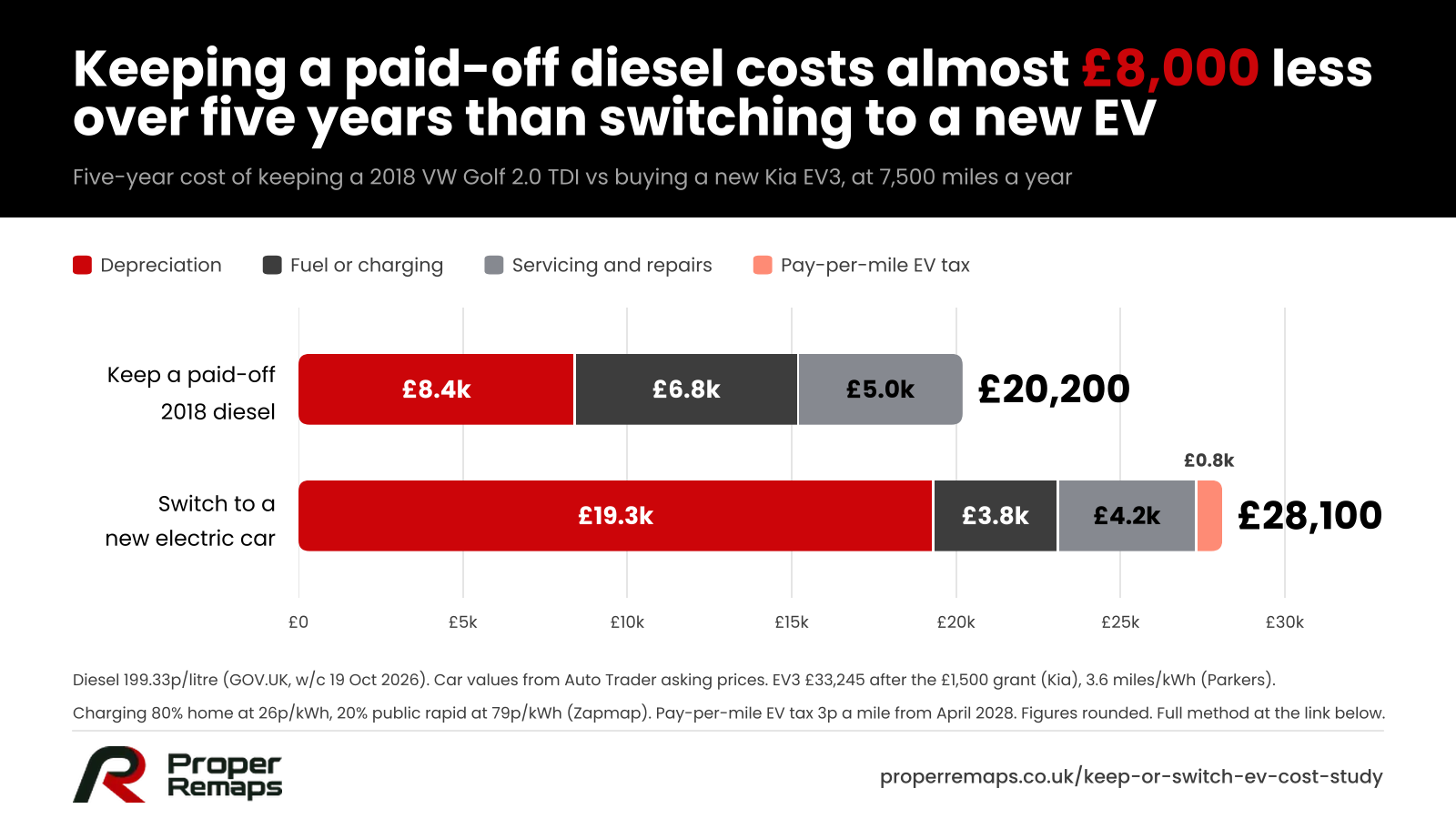
| Cost over five years (7,500 miles a year) | Keep the diesel | Switch to a new EV |
|---|---|---|
| Depreciation | £8,400 | £19,300 |
| Fuel or charging | £6,800 | £3,800 |
| Servicing and repairs | £5,000 | £4,200 |
| Pay-per-mile EV tax (from April 2028) | £0 | £800 |
| Total | £20,200 | £28,100 |
The electric car wins on running costs, saving around £3,000 on fuel and £800 on servicing. But it loses about £10,900 more in value, which wipes out those savings and more. All figures are rounded to the nearest £100.
Should You Keep Your Car or Switch?
Keeping Makes Sense If
- Your car is paid off and in good mechanical health
- You drive an average or lower mileage
- You’d rely on public chargers because you don’t have a driveway or home charger
Switching Makes Sense If
- You drive high mileage and can charge cheaply at home overnight
- Your current car needs major, expensive repairs
- You were going to replace your car soon anyway
This study is about cost only. It doesn’t compare emissions, and it doesn’t say electric cars are a bad choice. It says that switching early, just because fuel is expensive, isn’t automatically the cheaper option.
The Expert View

“The cheapest car is usually the one you already own. If your car is paid off and in good health, look after it and get the most out of every litre until switching makes sense for you. A remap can often help with fuel efficiency as well.”
Arturs Kupce, Software Engineer, Proper Remaps
Getting More From the Car You Keep
If you’re keeping your car, a few things make a real difference to what it costs you:
- Keep up with servicing. Clean filters, fresh oil and correct tyre pressures all protect your fuel economy.
- Drive smoothly. Gentle acceleration and reading the road ahead save more fuel than most people expect.
- Consider an economy remap. An economy remap adjusts your engine’s software for efficiency rather than outright power. Results vary by car and driving style.
Want to know what your car could gain? Try our free remap calculator or see how our mobile remaps work.
Frequently Asked Questions
For most drivers with a paid-off car in good health, keeping it is cheaper over the next five years. In our study, keeping a 2018 diesel saved almost £8,000 compared with buying a new EV at 7,500 miles a year.
Yes. Charging at home costs much less than diesel per mile, and servicing is cheaper too. The extra depreciation on a new car is what outweighs those savings.
The numbers improve for high-mileage drivers who charge cheaply at home overnight. In our best case for the EV, 12,000 miles a year on an off-peak tariff with strong resale value, the two options came within £800 of each other.
They’re the worst affected. Relying on public street chargers at around 54p per kWh pushed the five-year gap to £9,700 in favour of keeping the diesel. Using rapid chargers would widen it further.
Yes. We included the planned 3p-per-mile charge on electric cars from April 2028.
How We Worked It Out
We compared the total cost of each option over five years, holding today’s fuel and energy prices steady. Where we had a choice, we mostly picked the option that favours the electric car.
| Input | Value used | Source |
|---|---|---|
| Diesel price | 199.33p a litre, week of 19 October 2026 | GOV.UK weekly road fuel prices |
| Diesel car | 2018 VW Golf 2.0 TDI, owned outright, 50mpg real-world (official figure up to 52.3mpg) | Official figure from Carbuyer; real-world figure is a Proper Remaps estimate |
| Diesel car value today | £14,375, the middle of £12,500 to £16,250 for cars with 60,000 to 70,000 miles | Auto Trader asking prices, October 2026 |
| Diesel car value in five years | £5,975, the middle of £3,750 to £8,200, using today’s prices for a 2013 Golf 2.0 TDI with 100,000 to 120,000 miles | Auto Trader asking prices, October 2026 |
| Diesel servicing and repairs | £5,000 over five years: five services (£1,345), cambelt and water pump (£549), front brakes (£319), five MOTs (£274) and £500 a year for age-related repairs | VW fixed prices via Carbuyer; repair allowance is a Proper Remaps estimate |
| Electric car | Kia EV3 Air or GT-Line, £34,745 list, £33,245 after the £1,500 Electric Car Grant | Kia UK |
| EV value after five years | 40% of list price | 2021 Kia Niro EVs at £12,500 to £15,700 (Auto Trader, October 2026) against a new price of £32,200 to £39,700 (Carwow) |
| EV efficiency | 3.6 miles per kWh | Average of Parkers’ two EV3 tests: 3.2 in a UK winter, 4.0 in warm weather (Parkers) |
| Charging prices | 26p/kWh at home, 8.9p/kWh off-peak, 54p/kWh public street, 79p/kWh public rapid | Zapmap Charging Price Index, September 2026 |
| Charging mix (main scenario) | 80% home, 20% public rapid | Proper Remaps estimate |
| EV servicing | £4,200 over five years: £4,022 average EV servicing plus three MOTs (years 3 to 5) | The Car Expert and Clear Vehicle Data, via EV Powered |
| Pay-per-mile EV tax | 3p a mile from April 2028, confirmed in July 2026 with legislation still to come | Which?, Carwow |
We left out costs that are the same for both cars, such as standard road tax, and tyres for both cars, even though EVs usually wear tyres faster. We used retail asking prices for the diesel, treated insurance as equal and assumed the EV was bought with cash, all of which favour the electric car. The 2021 Niro EVs we used to estimate the EV’s future value have covered more miles than ours would, so the EV could hold slightly more of its value.
How sure are we? Keeping the diesel came out cheaper in every version we tested. The gap moves most with the diesel’s value: across the full Auto Trader price ranges, it runs from £3,900 to £12,100. If the EV kept 45% of its value instead of 40%, the gap would be £6,200. Your own costs will depend on your car, your mileage and how you charge.
Ready to get started?
Trusted by more than 500 drivers who’ve unlocked their car’s true potential.
Instant WhatsApp chat
Book a Remap